
ALEPH
Short-lived, task-scoped working context. Active and ephemeral.
HumaGenic AI™ Research
HumaGenic AI™ is Unshaken Voice Productions’ framework for designing AI as a coordinated, human-directed system of reasoning, memory, evidence, communication, safety, action, records, and shared human responsibility.
The research now spans the foundation client guide and source-grounded organism ecology studies: how can AI become more useful without becoming opaque, uncontrolled, or disconnected from human responsibility?
Research note: this language describes a practical system model. HumaGenic AI™ does not claim that AI possesses human identity, consciousness, spiritual equivalence, or authority over human judgment.

21
research articles
2
research volumes
8
service areas
5
responsibility roles
Why it matters
This page is written for serious readers: investors evaluating direction, executives evaluating adoption, clients evaluating trust, and partners evaluating whether the service approach deserves deeper collaboration.
HumaGenic AI™ frames UVP as more than a product studio: it is a research-driven service approach company building a reusable doctrine for guided, human-directed AI systems.
The framework explains how UVP thinks about safe automation, memory, tools, and action: useful intelligence that remains scoped, reviewable, and accountable.
The research surface invites expert critique, pilot collaboration, institutional dialogue, and field feedback without exposing confidential project details.
Framework, product, and service
HumaGenic AI explains the method. Aleph is the governed operating architecture. Agents are specialist roles. AI Systems are the solutions built around real work. Consultation is how UVP teaches, configures, tests, and hands the system to an organization.
Core principles
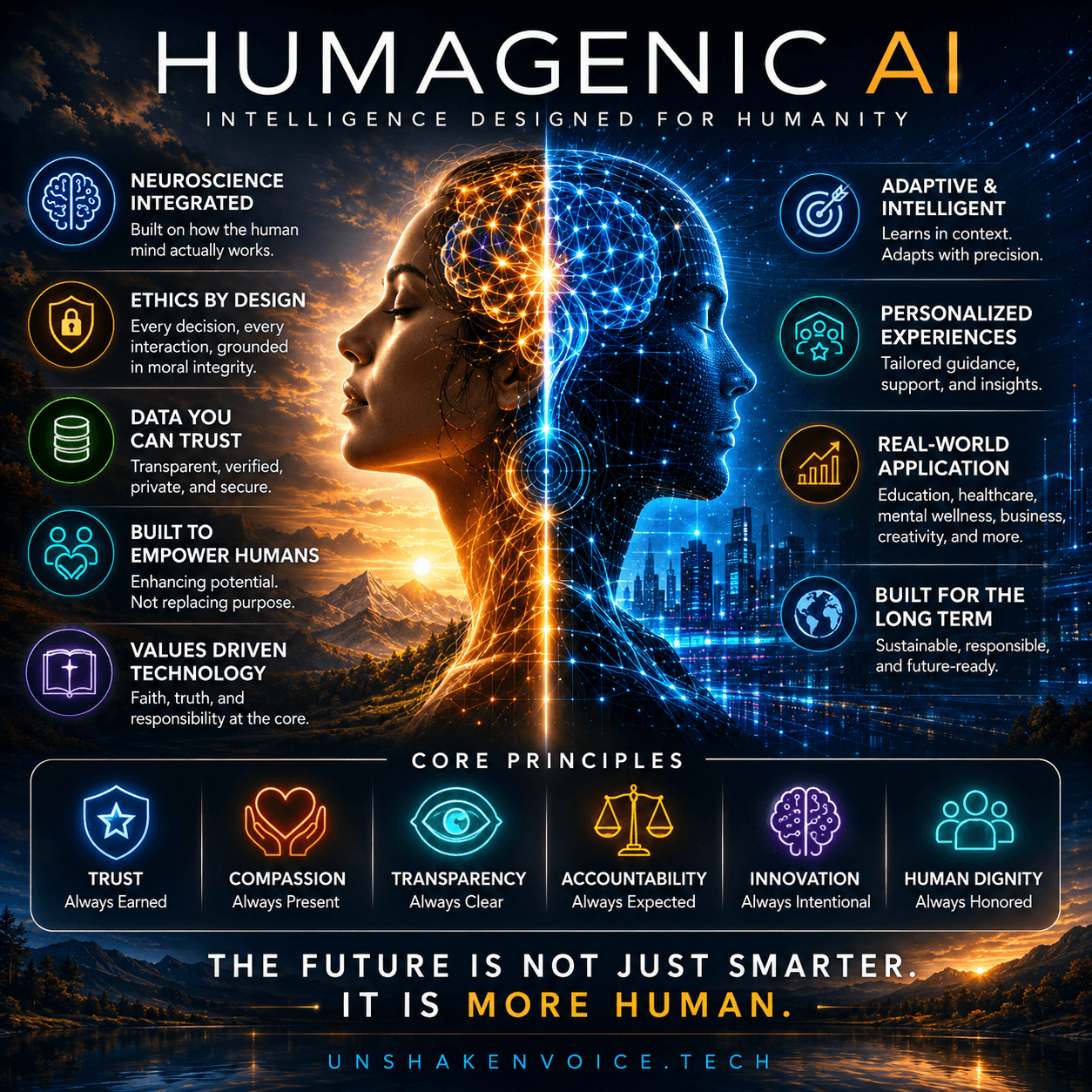
AI safety is a collective obligation, but collective does not mean vague. Builders, organization leaders, domain experts, operators, and affected people each have a role; consequential actions still require a named human approver.
Values in practice
HumaGenic AI research treats values as service requirements: systems should make their safeguards visible, preserve human dignity, identify where trust is earned, distribute review across the people involved, and assign final approval for every consequential action.
Public invitation
UVP is interested in rigorous outside response: what feels useful, what feels incomplete, what needs sharper terminology, and what practical pilots could test the service approach in the real world.
Whole-organism explorer
ALEPH is now directly explorable on the main HumaGenic AI™ page. Rotate the organism, explode its anatomy, isolate organs, inspect internal systems, trace governed signal flow, and see how Human Authority remains external and final.
Accessible architecture fallback
The 3D view is not the sole source of information. Select any system below with keyboard or pointer input.
Core organs, constitutional layers, physiology, evaluation, and operator surfaces.
The current Aleph agent registry: one supervisor and its declared subordinate agent roles. These roles do not override organ ownership or Human Authority.
Named UVP domain specialists that inherit the shared organism rather than becoming sovereign systems.
Domain and product phenotypes expressed through the common Genome, routing, security, evidence, and human-authority model.
These are system layers, not standalone agents. Architecture Layers mode renders their spatial relationship around the organism.
ALEPH
Short-lived, task-scoped working context. Active and ephemeral.
Sopher
Source-linked knowledge and evidence. Retrieval and synthesis remain provenance-bearing.
Zakar
Durable, reviewed continuity. Pending or rejected memory is not recalled as approved continuity.
Sefer
Authoritative adopted record and canon. Comparatively immutable and source-of-truth anchored.
The 3D model is generated from the versioned public-safe organism manifest. It represents configured architecture and research state, not fabricated production telemetry.
AI Guidance Series
These briefs introduce the language, trust safeguards, and service approach behind the client education series before Volume II expands into organism ecology and resilience.
Article 01 · Client guide
HumaGenic AI is Unshaken Voice Productions' framework for designing artificial intelligence as a coordinated, guided system rather than a collection of disconnected models and tools.
7 min read · AI Guidance Series Volume I
Open full article
Article 02 · Client guide
Human oversight is often added to AI systems as a disclaimer: a sentence that says a person remains responsible, even though the technical system is designed to proceed as far as possible without interruption.
7 min read · AI Guidance Series Volume I
Open full article
Article 03 · Client guide
A human-guided AI system is a service approach in which specialized AI capabilities are organized as coordinated service areas under explicit human oversight.
7 min read · AI Guidance Series Volume I
Open full article
Research Volume II
The refreshed research collection adds seven source-grounded studies on biological-computing ethics, symbiotic ecology, contextual defense, digital dysbiosis, regulated stability, response diversity, and nested ecosystems.
Article 15 · HumaGenic Research Volume II
A source-grounded opening study for Volume II on biological-computing ethics, organoid-intelligence limits, and the boundary discipline HumaGenic AI™ must preserve.
2026-09-14 · 10 min read
Open full article
Article 16 · HumaGenic Research Volume II
A deep study of biodiversity exposure, host–microbiome interaction, and what these relationships suggest for a governed AI organism embedded in an external ecosystem.
2026-09-14 · 10 min read
Open full article
Article 17 · HumaGenic Research Volume II
A deep study of immune tolerance, danger signaling, artificial immune systems, and how contextual classification can improve governed AI safety architecture.
2026-09-14 · 10 min read
Open full article
Article 18 · HumaGenic Research Volume II
A deep study of dysbiosis as a systems concept and its application to multi-agent concentration risk, memory imbalance, feedback loops, and dependency health.
2026-09-14 · 10 min read
Open full article
Article 19 · HumaGenic Research Volume II
A deep study of homeostasis, robustness, adaptive control, and how a governed AI organism can maintain stability without becoming rigid.
2026-09-14 · 10 min read
Open full article
Article 20 · HumaGenic Research Volume II
A deep study of response diversity, ensemble disagreement, multi-agent debate, correlated failure, and how to design useful diversity into a governed AI organism.
2026-09-14 · 9 min read
Open full article
Article 21 · HumaGenic Research Volume II
A deep study of nested ecological relationships and how external environments, infrastructure, institutions, and people shape the behavior of a governed AI organism.
2026-09-14 · 9 min read
Open full article
Service Areas
Each area gives researchers, executives, and builders a place to ask better questions about responsibility, risk, coordination, and trust.
Article 04
Article 05
Article 06
Article 07
Article 08
Article 09
Article 10
Article 11
Research disciplines
The cross-cutting disciplines are the connective proof system of the framework: evidence, evaluation, and provenance make the system inspectable.
The system retrieves the right evidence from the right source under the right authority, then preserves enough context for claims to remain grounded and auditable.
Behavior is measured before automation is trusted. The framework treats scenarios, review records, follow-up checks, and outside critique as part of the service approach.
The system records what was requested, what evidence was used, what safeguards applied, what changed, and who approved it.
Research questions
Questions, field observations, and testable use cases become structured research notes that can strengthen the framework over time.
Identify what should be tested, clarified, strengthened, challenged, or explained more precisely.
Attach sources, observed use cases, partner context, user impact, or practical constraints that make the question worth examining.
Route the response toward article revision, lab-log entry, pilot design, expert review, or direct collaboration.
Interconnectivity research
HumaGenic AI research studies how reasoning, memory, retrieval, safety, communication, and action can remain connected without becoming uncontrolled or opaque.

The research focus is not simply whether AI systems can connect, but whether their connections remain understandable: what carries a request, what remembers context, what verifies evidence, what limits action, and where responsibility, review, and approval stay visible.
Latest lab movement
2026-09-14 · Active research
The public research collection now prepares twenty-one articles: the original AI Guidance Series plus seven source-grounded Volume II studies on organism ecology, boundary discipline, contextual defense, resilience, and adaptive regulation.
2026-09-14 · Active research
The research source registry now includes current governance references from NIST AI RMF activity, the NIST Generative AI Profile, and ISO/IEC 42001 management-system guidance.
2026-08-25 · Recorded
UVP recorded HumaGenic AI™ as a client-facing service approach doctrine for human-patterned, guided intelligence while preserving the safeguard that AI is not human, alive, conscious, or morally autonomous.
2026-08-28 · Published
The first fourteen client education articles establish the foundation briefs, system-layer articles, and cross-cutting research disciplines for open review and collaboration.
2026-08-28 · Active research
The site now invites investors, researchers, builders, institutions, and field partners to challenge, refine, and strengthen the framework through practical dialogue.